Product0-to-1SaaS

Iris: Building an Experimentation Platform From 0-to-1

I conceived, designed, and led the development of Iris — a SaaS platform that manages the full experimentation lifecycle for 300+ clients and 12,000+ experiments. Here's the problem it solved, how I built it, and what it delivered.

$2M+
Revenue Generated
300+
Clients
12,000+
Experiments Managed
30,000+
Hours Saved

The Experimentation Lifecycle

Experimentation at scale is a workflow problem. Iris solves it end-to-end.

Click any stage to see where Iris fits in. AI-powered capabilities are marked with a badge.

💡
Ideation
2 features
🎯
Prioritization
2 features
📝
Specification
3 features
🔧
Build / QA
2 features
📊
Live / Analysis
3 features
📈
Reporting & Learning
3 features
💡

Ideation

Generate and refine experiment hypotheses grounded in data and user behavior.

🤖
Agentic IdeationAI

Ask Iris generates experiment ideas using page screenshots and historical insights

🤖
AI Hypothesis WritingAI

AI-assisted hypothesis creation and review based on structured frameworks

🤖
AI-powered (Ask Iris / ImpactLens)
⚙️
Core platform

The Problem

Experimentation programs don't fail because of bad ideas. They fail because of bad infrastructure.

Cro Metrics runs experimentation programs for enterprise clients — companies like Zillow, Atlassian, Calendly, and Bombas. At any given time, we were managing hundreds of experiments across dozens of clients, each with its own hypotheses, specs, build requirements, QA cycles, and analysis reports.

Before Iris, experiment data was scattered across Airtable, Jira, Google Sheets, and tribal knowledge. Program managers and growth strategists both felt the pain — PGMs spent hours on status tracking and reporting instead of operational improvements, while strategists couldn't find past learnings or move experiments efficiently between stages. When a new strategist joined a client account, there was no way to surface what had already been tested and learned.

The problem wasn't a lack of talent or testing ideas. It was that experimentation at this scale demands purpose-built tooling — and nothing on the market was designed for how agency-led experimentation programs actually work.

⚙️
Operational Inefficiency
Experiment data scattered across Airtable, Jira, and Sheets. PGMs and strategists lost hours to status tracking, handoffs, and context-switching between tools.
🔍
Forgotten Insights
No centralized way to search what had been tested, what worked, and what didn't — across thousands of experiments.
📊
Reporting Lag
Client and leadership reporting required manual data pulls and compilation. Without real-time proof of ROI, client confidence eroded — and so did retention.

What I Built

A system of record for the entire experimentation lifecycle.

Iris is a web application that manages experiments from ideation through analysis and reporting. It's the single source of truth for every experiment — its hypothesis, specification, status, results, and learnings — across every client and program.
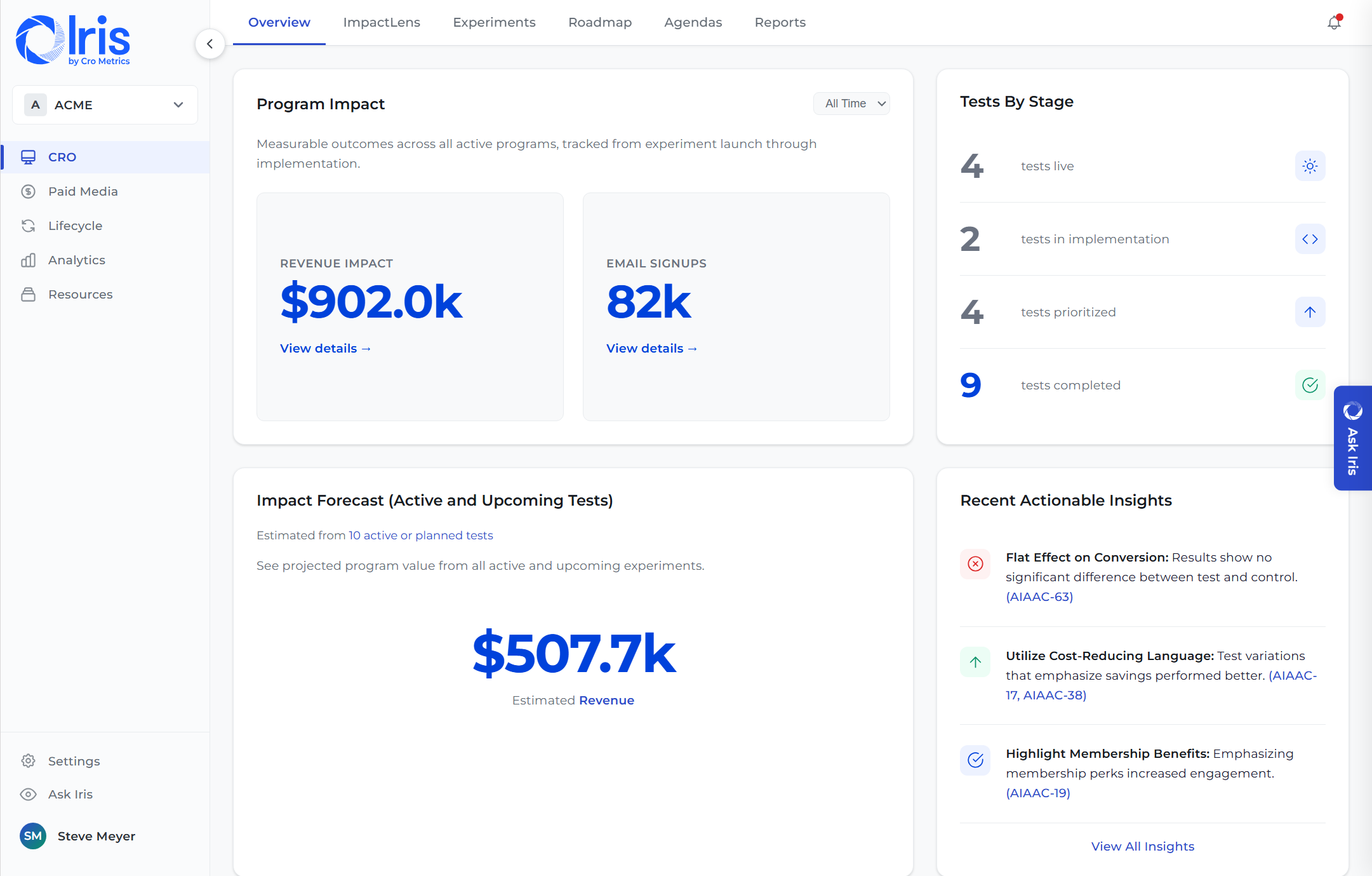
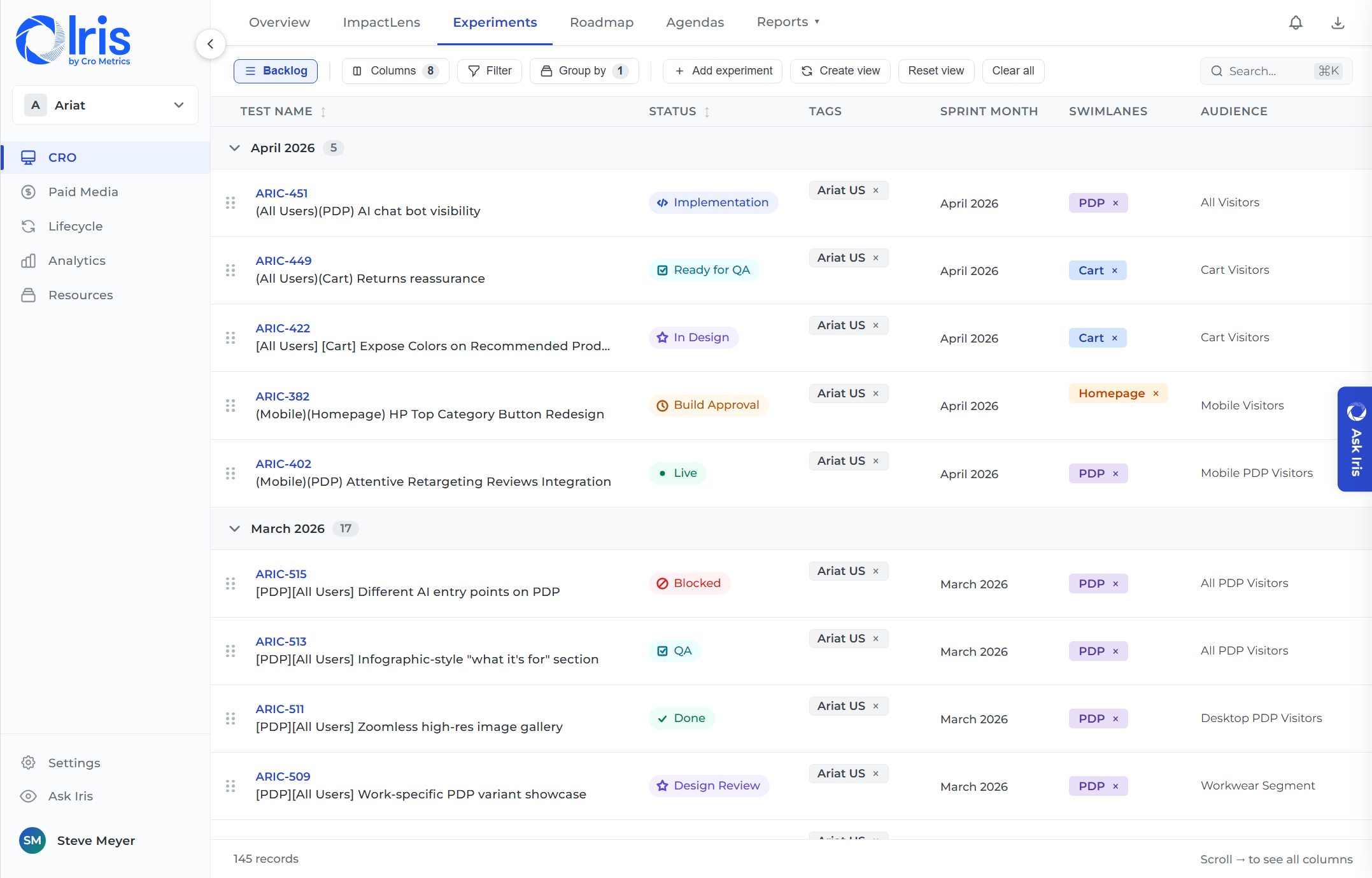
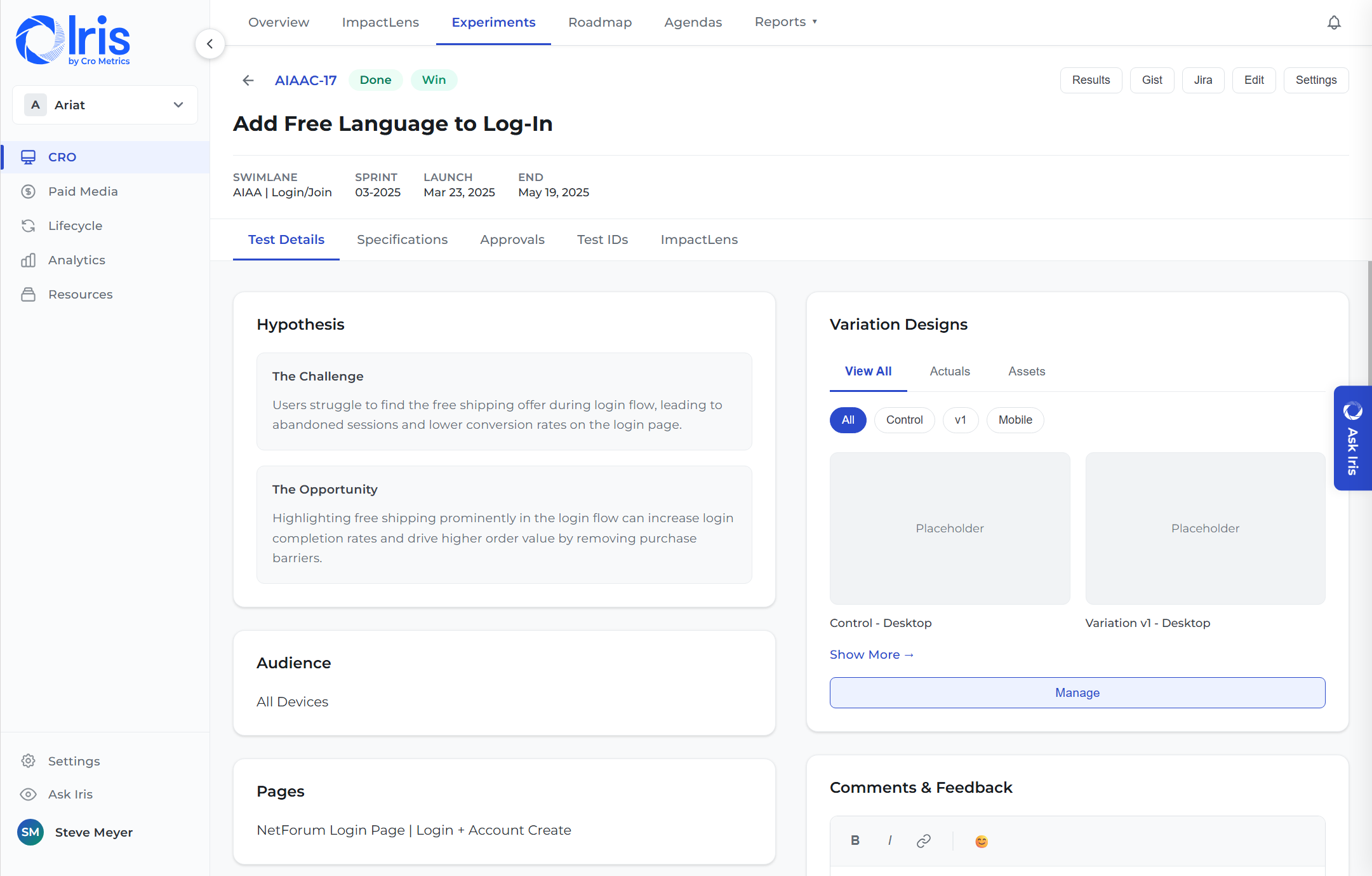
Iris client overview — program health and experiment pipelineIris experiment backlog — manage experiments across clientsIris experiment detail — hypothesis, specs, and variation designs

Core capabilities I defined and shipped:

Experiment Lifecycle Management
Every experiment tracked from hypothesis through analysis — with stage gates, ownership, and status visible in real time.
Client Program Dashboards
Real-time views of program velocity, win rates, and pipeline health — replacing hours of manual reporting.
Multi-Tenant Architecture
Isolated client environments with role-based access, enabling 300+ clients to operate on a single platform.
Client Approval Workflows
Built-in approval flows that reduced the #1 bottleneck in experiment velocity — waiting on client sign-off.
Experiment Specifications
Structured spec templates that standardized the handoff from strategy to engineering and QA.
Results & Learning Repository
Searchable archive of every experiment and its outcomes — solving the institutional knowledge problem.

My Role

Conceived it. Designed it. Led it from zero to production.

Iris started as a problem I kept running into while leading enterprise experimentation programs. I saw the same operational friction across every client — status tracking in spreadsheets, specs in docs, results buried in email threads. I pitched the concept to leadership, defined the product vision and initial feature set, and led it from first prototype to a production platform serving the entire client base.

As Director of Product, I own the roadmap, define priorities, and lead a 3-person product engineering team. I collaborate across design, management, client services, engineering/QA, and marketing/sales to align product decisions with business objectives. I also established the monetization model that turned Iris from an internal tool into a revenue-generating SaaS product.

Strategy
Product vision, roadmap, prioritization, success metrics
Discovery
Client interviews, pain point analysis, market validation
Execution
Feature definition, sprint planning, cross-functional team leadership
Growth
Adoption strategy, monetization model, stakeholder alignment

How I Thought About It

Key product decisions that shaped the platform.

Why build instead of buy?
We evaluated existing project management and experimentation tools. None of them modeled the actual workflow of an agency-led experimentation program — where strategists, engineers, QA, and clients all need different views of the same experiment at different stages. The buy vs. build analysis came down to a simple insight: our workflow is our competitive advantage, and the tooling needed to reflect that.
How did I prioritize the feature set?
The initial version was deliberately narrow — experiment tracking, status management, and client visibility. I resisted the temptation to build a full analytics suite or reporting engine first. The insight was that the most painful problem wasn’t analysis — it was that nobody knew what was running, what was next, and who was waiting on what. We solved the coordination problem first, then layered in analytics, approvals, and eventually AI capabilities.

What Came Next

Iris became the foundation for AI-powered experimentation.

Once Iris established a structured data layer across 12,000+ experiments, it unlocked something bigger: the ability to build AI products on top of real experimentation data. That foundation led directly to two AI capabilities I built and shipped:

📊
ImpactLens
A predictive modeling engine that uses historical experiment data to forecast which tests will drive the highest impact — lifting average client outcomes by 103%.
See ImpactLens case study
💬
Ask Iris
An agentic AI that does the work — prioritization, spec writing, and analysis — by querying the full experiment database conversationally.

Building an experimentation platform?

I've done it from zero — product strategy, architecture decisions, team leadership, and scaling to hundreds of clients. Let's talk about what you're building.

Get in Touch